
The Art of Playing
वादनकला (Vādanakalā)
The veena demands years of dedicated practice to master—not because it's mechanically difficult, but because true mastery requires integration of physical technique, musical knowledge, and aesthetic sensitivity.
Asana: The Foundation
Proper posture determines everything—tone production, stamina, injury prevention, and expression. Traditionally played seated cross-legged (Sukhasana), with the kudam on the left thigh and gourd on the right.
Key Checkpoints
- Back straight, shoulders relaxed
- Kudam stable on thigh
- Left elbow distinct from body
- Avoid hunching forward
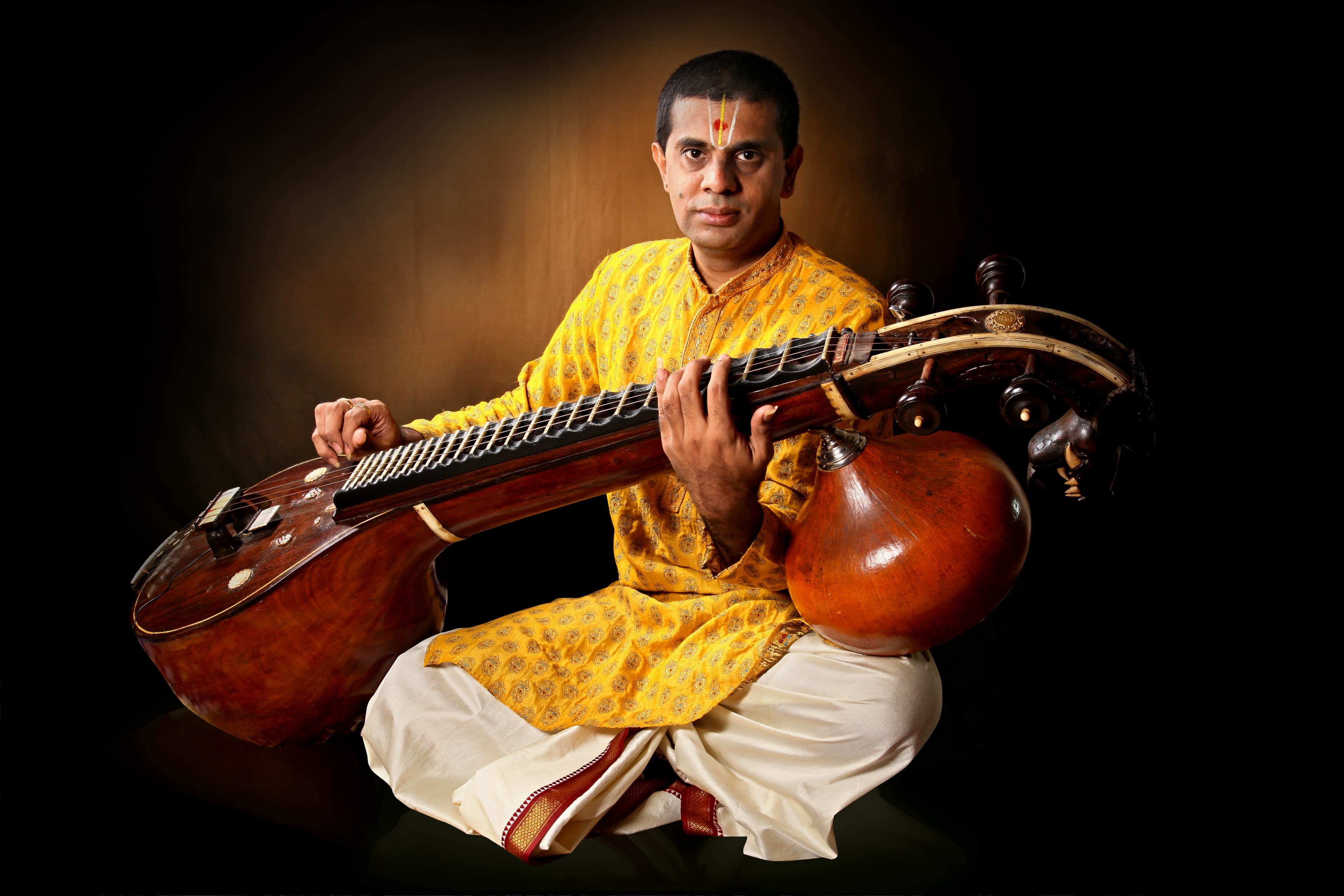
Right Hand Technique
Index Finger
Tarjani
Primary plucking finger. Strikes toward the palm. Produces standard articulation.
Middle Finger
Madhyama
Secondary plucker. Used for alternation (Index-Middle) to achieve speed and even tone.
Little Finger
Kanishthika
Used exclusively for striking the drone strings (Tala strings) in upward or downward motion.
Touch & Plucking Point
Where you pluck matters. Near the bridge creates a brighter, metallic sound (brilliant). Towards the fretboard creates a mellower, fundamental-heavy tone. Kachchapada (Tortoise) and Kukudapada (Rooster) describe hand shapes.
The Art of Meetu & Gamaka
The left hand stops the strings (Meetu) and creates the curved oscillations (Gamakas). Pulling the string sideways increases tension, creating the fluid microtonal movement unique to Carnatic music.
Rapid pull-release cycles creating a wide vibrato.
Smooth gliding from one note to another without breaking sound.
Guru-Shishya Parampara
Stage 1: Sarali Varisai
Basic scale exercises to establish hand positioning.
Stage 2: Janta Varisai
Doubled notes to build strength and coordination.
Stage 3: Alankaras
Seven rhythm-based scale patterns.
Stage 4: Geetams
Simple songs combining melody and rhythm.
Stage 5: Varnams
Complex études encompassing all technical aspects.
Stage 6: Manodharma
Art of improvisation (Alapana, Tanam, Pallavi).