
Scholarship & Living Inquiry || 2014–2026
Where scholarship meets
the living string.
At Veena Tattva Prakashika, research is never separated from the hands that play, the ears that listen, or the artisans who shape the wood. For over a decade, this forum has brought together veteran vainikas, medical researchers, acoustic physicists, and Sanskrit scholars in an open, interdisciplinary dialogue—exploring the Saraswati Veena not merely as an instrument of antiquity, but as a living science of sound, mind, and spirit.
Documented below are 44 papers, lecture-demonstrations, and scholarly panels presented across six editions. Each entry reflects a shared journey to illuminate the instrument’s true nature (tattva)—from the biomechanics of plucking and neurological studies of ragas to the subtleties of fret-setting and ancient treatises.
Index || Edition by edition
Everything presented,
as the programmes list it.
VTP VI 2026
30 January – 1 February 2026
MES Kalavedi, Malleswaram, Bengaluru
Theme: Dikshitar kritis, Pallavi in allied talas.
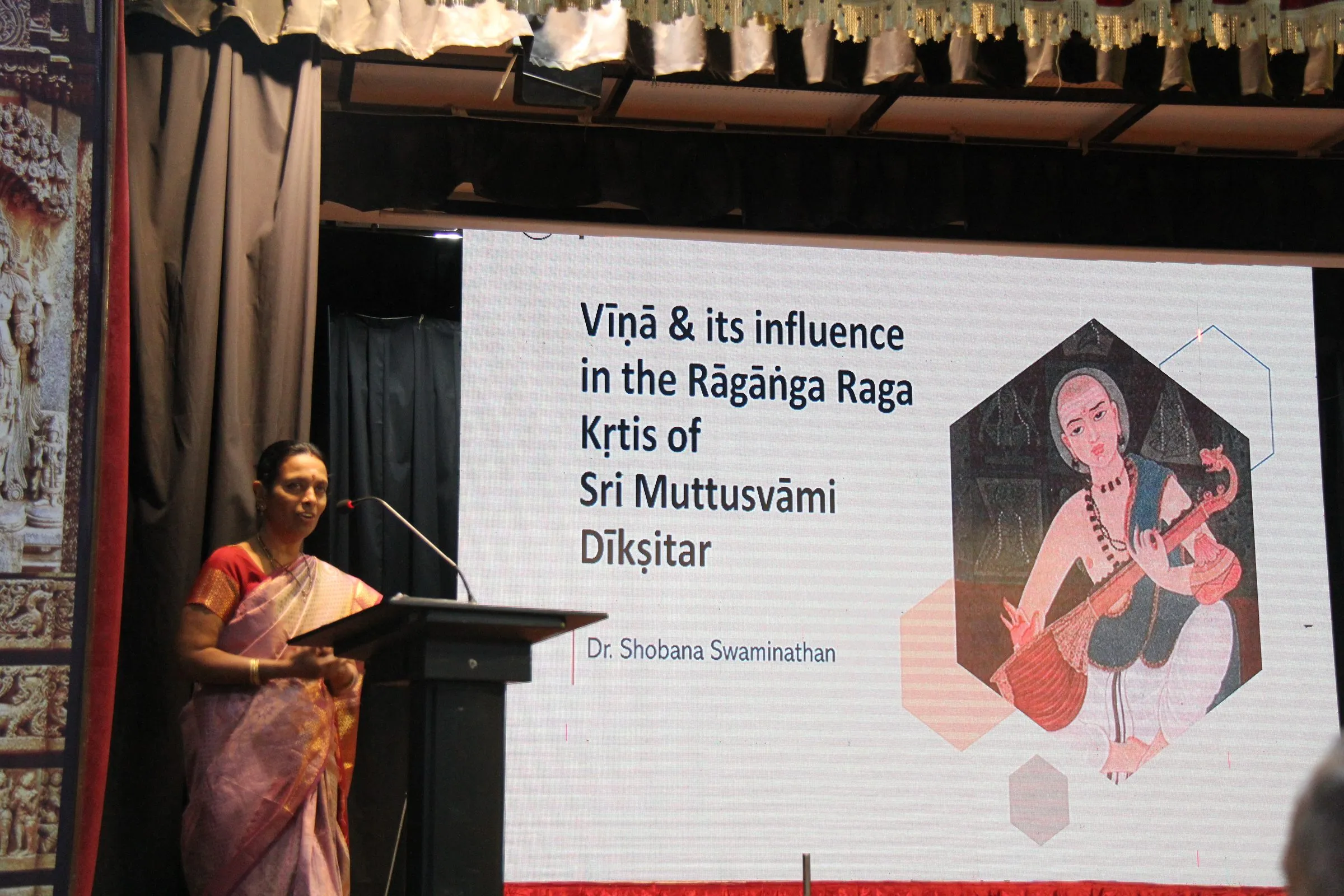
Veena and its influence in the Raganga Raga Kritis of Dikshitar
Dr. Shobana Swaminathan
Gamaka Prayoga in Pancharatna Krithis – An Interesting Tale
Dr. R. S. Jayalakshmi
Instrumental Aesthetics and the Grammar of Dikshitar’s Ragas
Vid. Revathi Sadashivam
Text, Tantra, and Tone: Veena as a Vehicle for Dikshitar’s Esoteric Vision
Dr. R. S. Nandakumar
Study of effect of veena music on heart rate variability and heart rate recovery indices after exercise in young adults
Dr. Prashanth Srinivasan
VTP V 2024
17–19 January 2024
PES University, Bengaluru
Rāsa Prajñāna academic sessions, dedicated to Mahamahopadhyaya Ra. Satyanarayana.
Veena adorned by deities, yogis and composers
Vidushi Revathi Srinivasan and Vidushi Shobana Swaminathan
Effect of ragas played on the veena on the human brain
Dr. Prashanth Srinivasan
Mela making demonstration
Vidwan Chitra Durga Dwarkish
Mathematics meets Veena: Veena signal analysis using Ramanujam and Fourier transforms
Dr. Anil
The aesthetics of mridangam accompaniment to veena and different schools of thought
Dr. P. Srinivas Gopalan
VTP IV 2022
4–6 November 2022
PES University, Bengaluru
SCOPA Rāsa Prajñāna academic sessions, dedicated to Mahamahopadhyaya Ra. Satyanarayana.
Gamaka and its prayoga in Sri Muttuswamy Dikshitar kritis
Vidushi Jayashri Jayaraj and Vidwan Jayaraj
Imaging of upper limb muscles in veena plucking
Dr. Durga Prasad
Study of gamaka prayoga in rakti ragas
Dr. R. S. Jayalakshmi
A scientific perspective of the Navagraha kritis of Sri Muthuswami Dikshitar
Dr. Veena Mohan
EEG study of brain response to veena concerning ragas in comparison with other string instruments
Dr. Prashanth Srinivasan
Mela-triad: an exposition
Dr. R. S. Nandakumar
Unique sound of veena and its scientific analysis
Nivedita D
Research scholar, Vels University
The unique techniques of gamaka prayoga in bhashanga ragas
Vidwan Mudikondan Ramesh
Adherence to the vainika sampradaya for maintaining the sanctity
Dr. R. S. Jayalakshmi, Vidwan Mudikondan Ramesh, Vidushi M. K. Saraswathi, Dr. Shobana Swaminathan, Vidushi Yoga Vandana, Vidushi Kashi Vishalakshi, Vidushi Revathi Sadashivam, Dr. Durga Prasad, Vidwan Duddu Seetaramaiah, Vidwan G. R. S. Murthy and Vidwan Prashanth Iyengar
National programme for the preservation of veena musical heritage
The Vidwath Sadas panel (as above)
VTP III 2019
23–24 November 2019
Ravindra Kalakshetra, Bengaluru
Celebrating the centenary of Padmabhushan awardee Vidwan Veena Doreswamy Iyengar.
Making of veena melam: veena and acoustic amplification technology, and its pros and cons
Vidwan Bharadwaj Raman
Study of the effect of veena nadam in the treatment of diabetes and hypertension
Dr. Jayashree
Varieties of tanam and its significance in playing of veena
Vidwan Duddu Seetharamaiah
A study of the historical development of veena from the past to the present, in lieu with the history of Bharata Desha (India)
Kalarathna Prof. Veturi Ananda Murthy
Bhasha Samman awardee of the Sangeet Natak Akademi, Delhi
Study of veena mentioned in Chaturdandi Prakashika
Dr. R. S. Nandakumar
Redefining classical music: instrumental veena towards transformation in individuals with special needs and neurological impairments
Dr. Geetha R. Bhat
Veena and Kannada literature
Dr. Nagendra Shastry
Place of veena in Pancharatra Agama Shastra
Vid. Kadambi Sethu Raman
Ragas, emotions, functional MRI
Dr. Durga Prasad
Vainika and radiologist
VTP II 2018
2–4 November 2018
Ravindra Kalakshetra, Bengaluru
Celebrating the centenary of His Highness Jayachamarajendra Wodeyar.
Veena tattva
Ve. Br. Vid. Mankala Srihari Sharma
Adaptation of Panchadasha gamakas in veena (practical demonstration, raga Shahana)
Vid. Prof. Dr. R. S. Jayalakshmi
Supported on veena by her disciple and granddaughter, Vid. Charulatha
The contribution of Mysore rulers to the promotion of veena
Shruti S
The role of posture in veena playing
Dr. Swathi S
Physiotherapist
Veena as in Shilpa Shastra
Vidwan Vinjamuri Narasimhan
Astrological significance in veena players’ horoscope
Tarakeshwari Murugeshan
PhD scholar, Annamalai University, Chidambaram
Veena in Sanskrit literature and poetry
Prof. Muralidhar Sharma
Research scholar, Karnataka Sanskrit University
Veena and its reference in Ramayana
R. Nandhini
PhD scholar, Department of Music, Avinashilingam Institute for Home Science and Higher Education for Women, Coimbatore
Playing of the Saraswati veena and its interplay with psychology of the musician and the audience
Sunil Anandatheertha
PhD scholar, Coventry University, United Kingdom
Paper The Mathematical and Scientific Principles Involved in the Design, Manufacturing, and Playing of the Saraswathi Veena and its Interplay with the Psychology of the Musician and the Audience
The subtleties in playing veena
Dr. Vijaya Raghavan
Anatomical study of the veena player’s hand
Vid. Prashanth Iyengar and Dr. Jayashree
Dr. Jayashree: research scholar, Karnataka Sanskrit University
The comparative study of veena with human body through CT and MRI
Dr. B. K. Durga Prasad
Radiologist, vainika and researcher
Paper The Veena’s Anatomy: A Radiological Perspective
Veena as represented in temple sculptures
Dr. Rama V. Bennur
Paradigm shift in raga Todi playing from the past to the present: a Fourier study
Dr. Y. G. Parimala
Veena in musicological texts
Dr. R. S. Nandakumar
VTP I 2014
17–19 January 2014
Mantralayam
Topics announced for the first conference on the conference’s 2014 website. No printed programme survives, so these record what was planned.
Veena and Veda, Mantra, Tantra shastra, Gayatri mantra
Vidwan Srihari Sharma
Role of veena in yajnas, Seemanthonnayana samskara and temple rituals
Presenter not named in the announcement
Making of veena melam
Prof. R. K. Murthy
Veena in comparison to the human body
Vidwan Veena Ananthapadmanabhan
Veena as a symbol of ancient Indian culture
Prof. Ra. Vishweshwaran
Contribution of Mysore Samsthan to the propagation of veena
Vidwan Shimoga Nagraj
Historical development of veena
Vid. Prashanth Iyengar
Gurukula system of veena education and best practices in teaching methodology
Pudukottai R. K. Murthy
Contribution of Karnataka to the historical evolution of veena
Vidwan Nandakumar
Principles involved in the design and development of veena
Dr. P. K. Srivathsa
Concept of Panchadasha and Dashavidha gamaka: practical demonstration
Prof. Ra. Vishweshwaran
The usage of classical veena in yesteryear films for emotional presentation
Presenter not named in the announcement
A welcome look at the varnam on the veena
Prof. Ra. Vishweshwaran
Role of media in the preservation and propagation of veena
Presenter not named in the announcement
Role of sabhas and rasikas in the propagation of veena
Presenter not named in the announcement
Nothing matches these filters.
Titles keep the wording printed in each brochure; only obvious misspellings have been corrected. Musical performances, ceremonies and breaks are listed in the brochures themselves.
Books launched || VTP V & VI
Released
at the conference.
VTP VI · 2026
Shri Tyagaraja Tattva Vaibhavam
Vidwan Prashanth Iyengar M. N.
VTP VI · 2026
The Karnataka Music Genesis
Vidwan Prashanth Iyengar M. N.
VTP V · 2024
The Science of Playing Veena: Exploring Body, Mind, and Music
‘Lakshminarasimha Dasa’ Vidwan Prashanth Iyengar
VTP V · 2024
My First Pluck: Exploring Biological Significance of Plucking
Dr. B. K. Durga Prasad
Questions || Corrections
Presented at VTP and missing from this index?
Write to info@veenaconference.com