
The Instrument
यन्त्रम् (Yantram)
Where art meets engineering. The veena's construction embodies principles that span acoustics, geometry, materials science, and aesthetics. Every measurement, every curve, every component serves both functional and symbolic purposes.
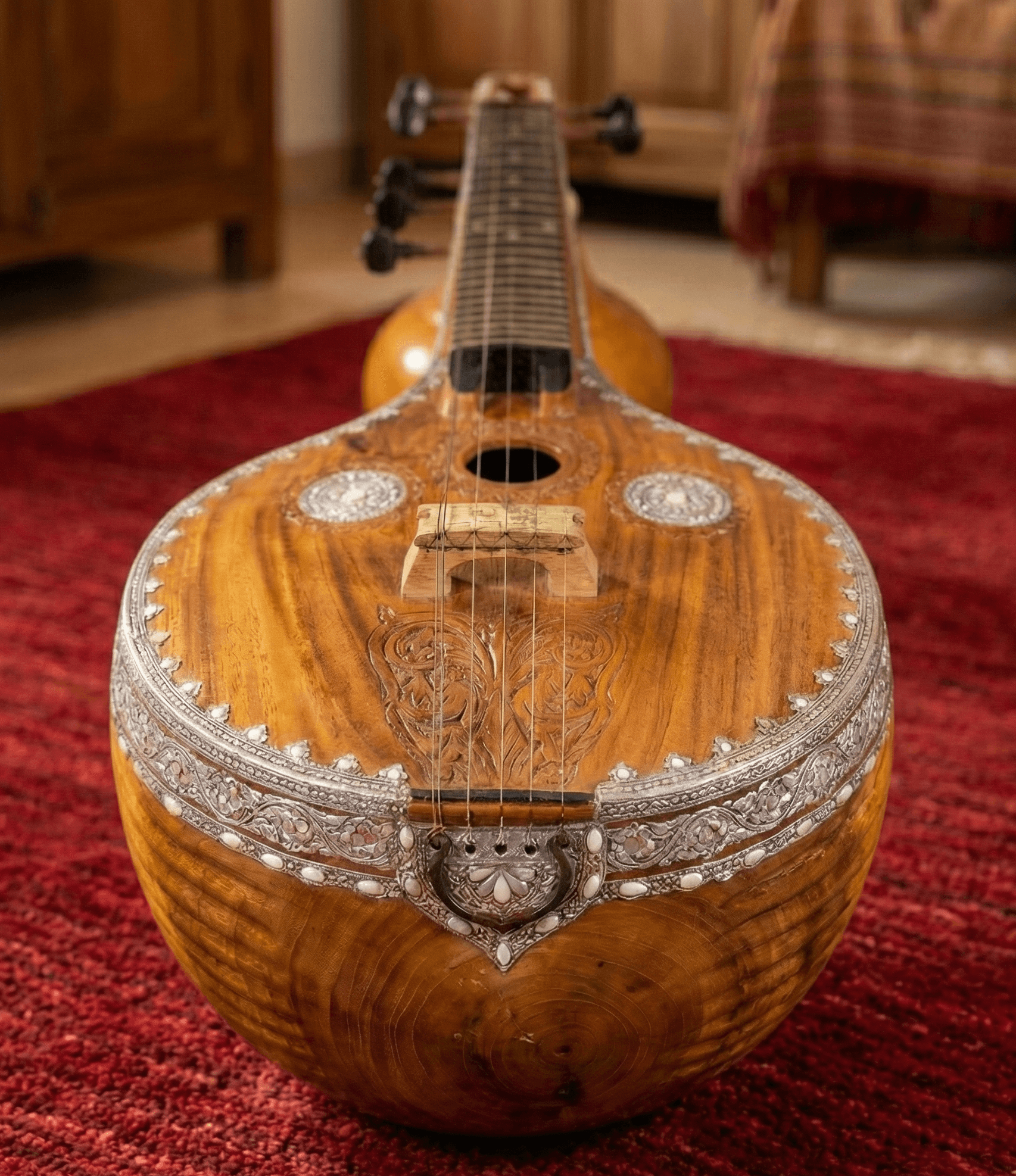
The Kudam (Body)
Traditionally carved from a single block of jackwood (Artocarpus heterophyllus), the kudam or body serves as the primary resonating chamber. The choice of jackwood is not accidental—its density, grain structure, and acoustic properties produce the veena's characteristic warm, sustained tone.
Typically 60-70 cm length, 30-35 cm width. Ratios reflect empirically discovered acoustic optima passed down through generations.
Curves serve aesthetic beauty (often compared to cosmic egg), ergonomic comfort, and acoustic projection.
The Dandi & Fretboard
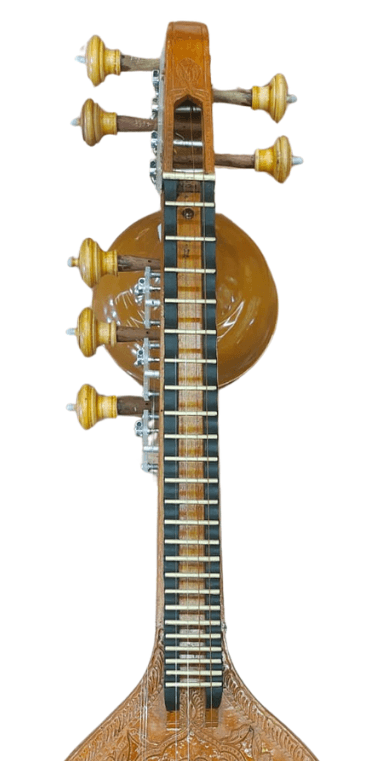
The dandi extends from the kudam (90-100 cm). This is where the musician's left hand pulls, bends, and manipulates strings to create infinite nuances. Carved from jackwood, it must withstand 50-60 kg of tension.
The 24 Fret System
24 brass frets are affixed using a traditional mixture of beeswax and rosin. This "movable fret" system allows for seasonal shruti adjustments. While there are 24 frets, they represent the 22 shrutis of the octave through playing technique.
The Naadis (Strings)
Seven strings grace the veena, divided into playing strings (vaadya naadi) and drone strings (thaalamu naadi).
Playing Strings (4)
- String 1 (Sarani) High Sa / Pa
- String 2 (Panchama) Pa
- String 3 (Mandra) Sa (Tonic)
- String 4 (Anumandra) Low Pa
Drone Strings (3)
- Side String 1 (Pakka Sarani) Sa
- Side String 2 (Pakka Panchama) Pa
- Side String 3 (Pakka Tara Shadja) High Sa
Anatomy of the Veena
The Gourd
Suvvi / SorivaiDried hollow gourd acting as secondary resonator for upper frequencies. Often decorative.
The Bridge
KuduraiCurved brass or wooden plate on resin base transferring vibrations to the soundboard.
Tuning Pegs
BuruguRosewood pegs with friction-fit design for precise tuning adjustments.
Dragon Head
YaliTraditional carved motif at the end of the dandi, symbolizing power and protection.
Soundboard
PalakaiThe resonating top surface of the kudam, carefully thinned for vibration.
Inlay Work
DecorationEtched polymer or ivory (historical) designs adorning the borders.
The Science of Materials
Why Jackwood?
- Density: 600-800 kg/m³ (Optimal acoustic range)
- Review stiffness-to-weight ratio for resonance
- Resists warping in humidity changes
- Traditional empiricism confirmed by modern physics
Beeswax Adhesive
- Allows seasonal adjustment of frets
- Acts as acoustic coupler transmitting vibration
- Specific mixing ratios passed down in lineages