
The Sacred Veena
नादब्रह्म (Nāda Brahma)
"Śabda brahmaṇi niṣṇātaḥ parabrahmadhigacchati"
"One who is immersed in the Brahman of Sound attains the Supreme Brahman"
Nada Brahma: Sound as Creation
Within Hindu philosophical frameworks, sound occupies a unique ontological position. Unlike Western traditions that tend to understand sound as merely a physical phenomenon—vibrations propagating through air—Indian thought recognizes nada (sound/vibration) as the fundamental creative principle of the universe itself.
The doctrine of Nada Brahma proposes that the unmanifest Absolute (Brahman) first manifests as primal vibration. This is not metaphorical—the Upanishads describe a cosmogony where the universe literally emerges from sound. The syllable Om is understood as the sonic representation of this primal vibration.
In this context, the veena is viewed as a yantra (instrument) for accessing these subtler dimensions of reality. Playing isn't just performance; it is a ritual technology.
The Goddess and Her Instrument
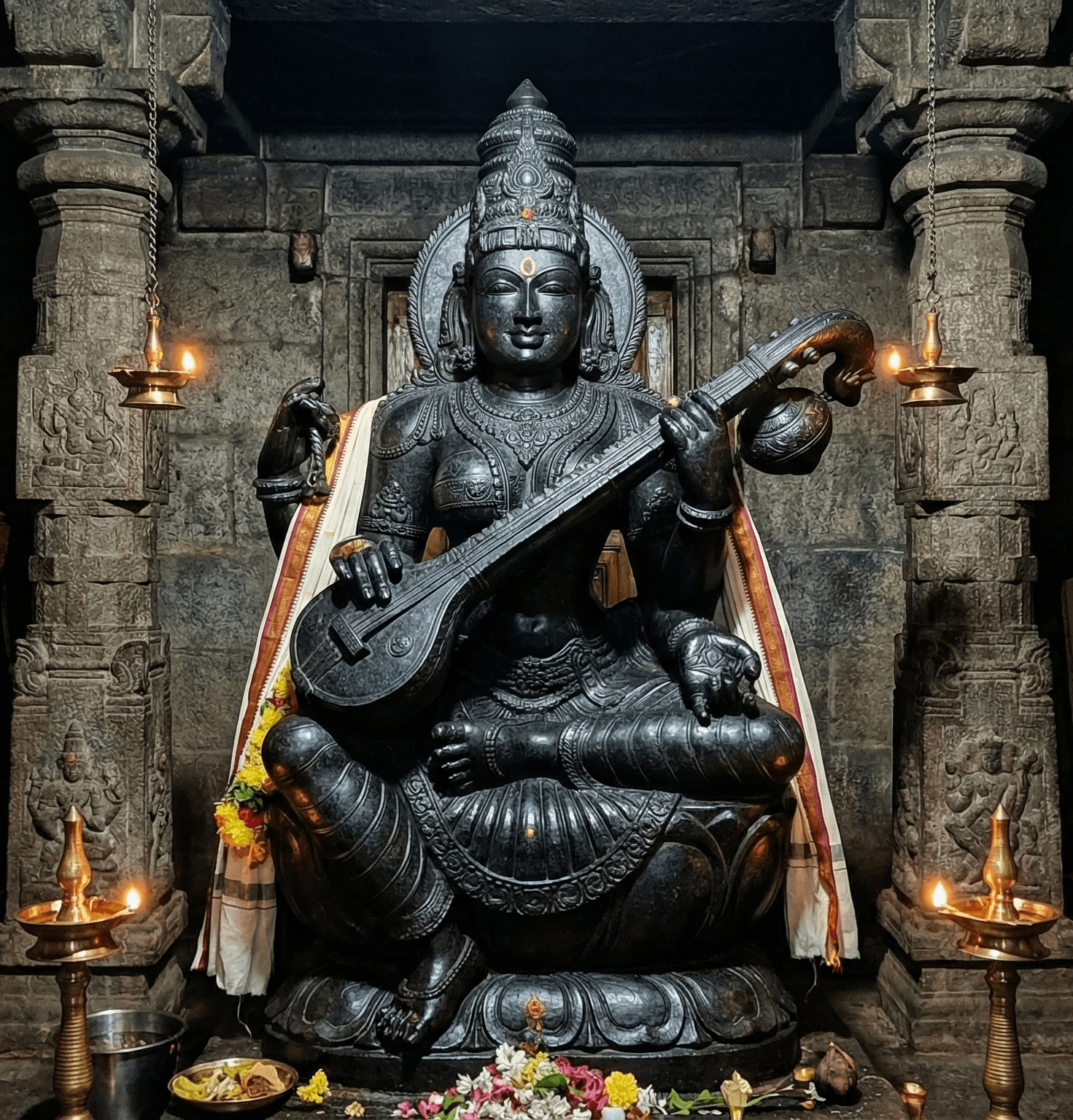
Goddess Saraswati, embodiment of wisdom (jnana) and creative arts (kala), is never depicted outside the company of her veena. In classical iconography, she holds the instrument diagonally across her body, representing the integration of knowledge and action.
Symbolism
Representing Shabda Brahman (sonic aspect of the Absolute) and harmony of the three gunas.
Ritual Context
Worshipped during Vasant Panchami and Navaratri. Musicians invoke her before every practice.
Ancient Roots
Rigveda
Hymns reference 'vana' (instrument of wood), likely an early harp-style proto-veena.
Hymns reference 'vana' (instrument of wood), likely an early harp-style proto-veena.
Samaveda
Establishment of chanting traditions requiring precise pitch, spurring instrument development.
Establishment of chanting traditions requiring precise pitch, spurring instrument development.
Natyashastra
Bharata Muni categorizes veenas (Chitra, Vipanchi) and details usage in demonstrating shrutis.
Bharata Muni categorizes veenas (Chitra, Vipanchi) and details usage in demonstrating shrutis.
Sangita Ratnakara
Encyclopedic treatment by Sharngadeva, establishing the theoretical framework used today.
Encyclopedic treatment by Sharngadeva, establishing the theoretical framework used today.
Nada Yoga & Practice
Beyond performance, the veena serves as a tool for interior transformation. The sustaint of the strings allows the listener to follow the sound into silence (laya), dissolving the distinction between observer and observed.
Ahata Nada
Struck, audible sound. The entry point for concentration.
Anahata Nada
Unstruck, internal sound heard in deep meditation.
Body as Veena
"The body is the veena, the Self the player." Ancient texts map the instrument to human anatomy.
- Dandi (Neck) = Spine / Sushumna Nadi
- Kudam (Body) = Hridaya (Heart Center)
- 24 Frets = 24 Vertebrae / Tattvas
- 7 Strings = 7 Chakras
*VTP Research confirmed anatomical correlations between fret spacing and vertebral column ratios (Dr. B K Durga Prasad).
Read Study