
The Sacred Instrument
Nada Brahma, Goddess Saraswati, and the veena's role in spiritual practice and temple traditions
Explore Spiritual Dimensions
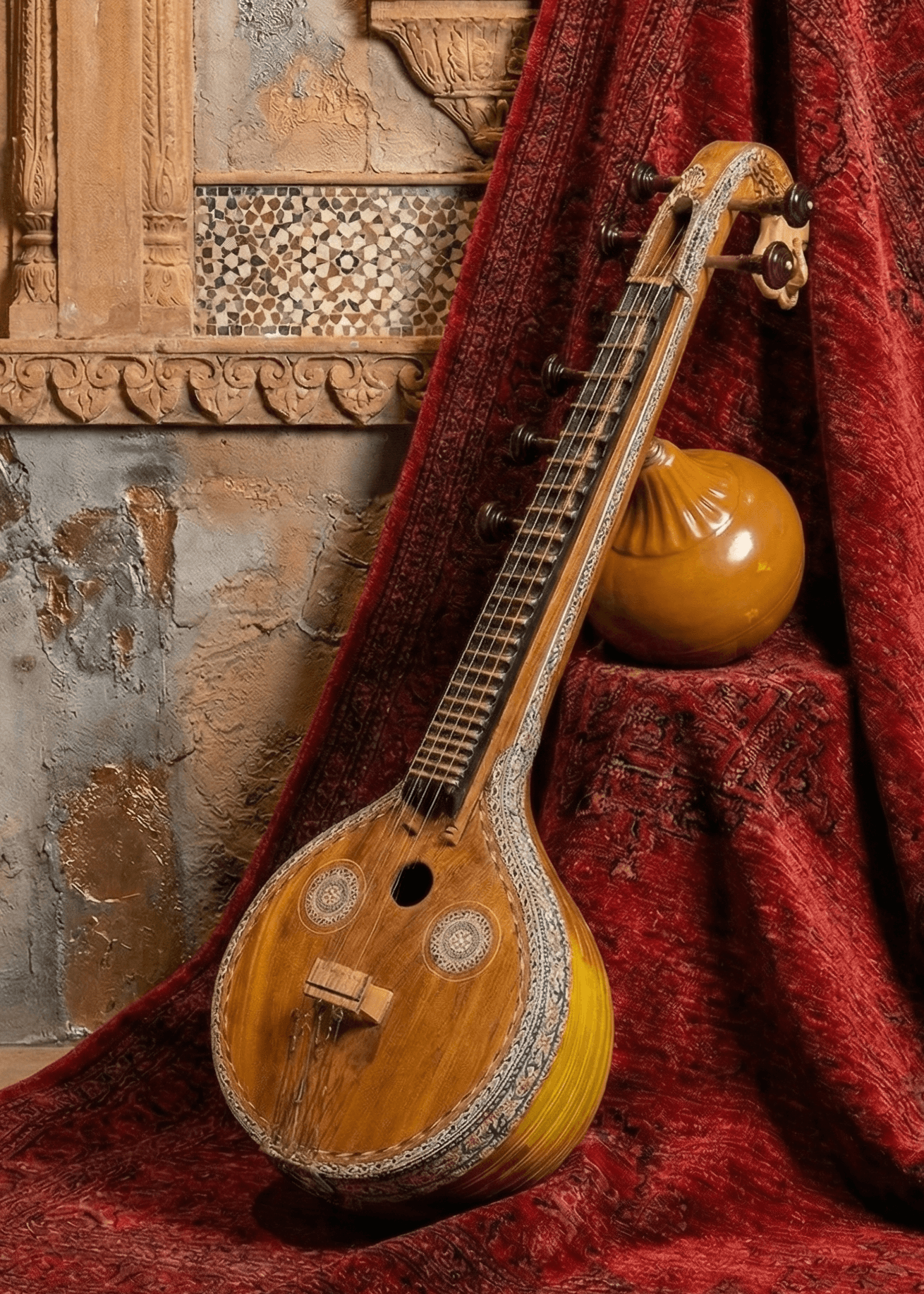
India's Foremost Melodic Instrument
"One who knows the principles of veena playing, is well-versed in shrutis and jaatis, and understands tala, easily attains the path to liberation."— Yajnavalkya Smriti
The veena stands as the archetypal instrument in Indian classical music—the standard against which all others are measured. Described in ancient texts as the instrument of Goddess Saraswati herself, the veena embodies not merely musical sophistication but a profound philosophical understanding of sound as the fundamental creative principle of the universe.
To understand the veena is to understand a worldview. In the hierarchy of instruments described in ancient musicological texts, the veena occupies the highest position—not because of chauvinism but because of its unique capacity to manifest the subtlest gradations of pitch, the most complex ornamentations, and the fullest range of emotional expression.
The Natya Shastra declares: "Among all instruments, the veena is supreme, for it alone can accurately demonstrate all twenty-two shrutis." This technical supremacy served a deeper purpose—the veena became the teaching instrument, the reference standard, the means by which the oral tradition could be preserved and transmitted with precision.
Yet the veena's significance extends far beyond its acoustic properties. It appears in temple iconography as Saraswati's constant companion, suggesting that knowledge itself requires this particular sonic vehicle. It figures in Vedic rituals, in metaphysical discussions comparing the human body to musical instruments, and in countless poetic descriptions of divine beauty.
Today, as VTP's research demonstrates, we are discovering that traditional claims about the veena's effects—therapeutic, meditative, consciousness-altering—can be validated through neuroscience, cardiology, and acoustic analysis. The veena remains what it has always been: a bridge between worlds.
Choose Your Path of Discovery
Nada Brahma, Goddess Saraswati, and the veena's role in spiritual practice and temple traditions
Woods, gourds, frets, strings—the principles and artistry behind veena construction
Acoustics, harmonics, resonance—understanding why the veena sounds as it does
Meetu, gamakas, left-hand techniques—the art of bringing the veena to life
From Vedic references to modern forms—tracing the veena's journey through centuries
Saraswati, Rudra, Vichitra—exploring the veena family and regional variations
For aspiring students—how to begin your journey with this divine instrument
Preserving your instrument—humidity, string care, tuning, and seasonal adjustments
Contemporary scientific studies exploring the veena's effects and properties
"Among all stringed and percussion instruments, the veena is the most excellent, for its fundamental sound continues to vibrate in the heart of every melody."
— Sangita Ratnakara
References in Vedic texts
Representing 22 shrutis
Traditional construction
Symbol of knowledge
4 main + 3 drone
Ornamental techniques