
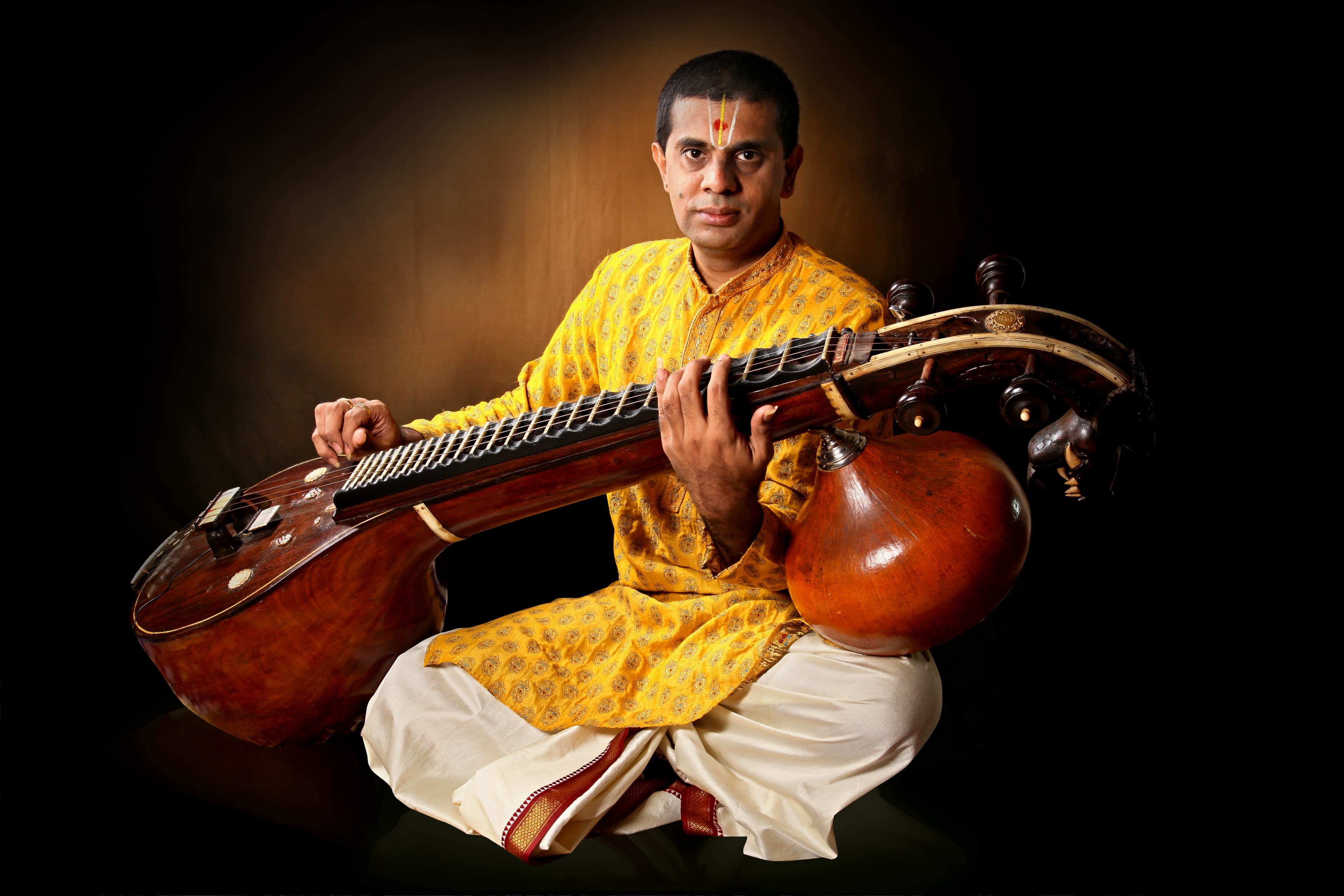
Kanchi Kamakoti Peetam Asthana Vidwan
Madukaram Prashanth Iyengar
Founder of the Sreerama Centre of Performing Arts (SCOPA) and the visionary behind Veena Tattva Prakashika, Vidwan Prashanth Iyengar has dedicated his life to bridging the devotional practices of ancient masters with contemporary research methodologies.
A Vision Born from Divine Grace
In 2014, I found myself standing at a crossroads. As both a practitioner deeply committed to the veena and a student of its broader significance, I had become increasingly aware of a troubling reality: despite the veena's exalted position in our tradition—described in our texts as the instrument of Goddess Saraswati herself—there existed no dedicated platform exploring its full dimensions.
Music conferences were plentiful, certainly. But where was the space for asking deeper questions? Where could we explore the veena not just as a performance instrument but as a spiritual tool, a scientific phenomenon, a cultural artifact?
The idea for Veena Tattva Prakashika emerged not from ambition but from necessity—or perhaps more accurately, from what I can only describe as divine intervention. The concept arrived fully formed: a conference that would honor the veena comprehensively.
"The veena is not merely an instrument we play—it is a yantra through which we participate in the cosmic sound that underlies all existence."
We started small, in Mantralaya, with faith as our primary resource. Today, seeing scholars present EEG data alongside vedic chanting, seeing young children take up the instrument with renewed pride, I know that the vision was not mine alone—it was the will of the Nada Brahma manifesting through us.
The Journey to VTP
Contributions to Veena Culture
- Founder, Sreerama Centre of Performing Arts (SCOPA)
- Author: "Shri Tyagaraja Tattva Vaibhavam"
- Author: "The Karnataka Music Genesis"
- Author: "The Science of Playing Veena"
Research Focus
Prashanth Iyengar has pioneered interdisciplinary approaches to veena study, collaborating with medical professionals, mathematicians, and neuroscientists. He bridges the gap between sampradaya (tradition) and contemporary inquiry.